



News & Stories
2024
News
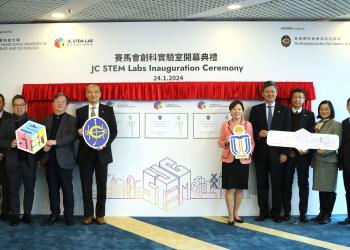
HKUST Commended for Research Excellence with Launch of Three JC STEM Labs
HKUST President Prof. Nancy IP (sixth right), Head of Charities (Positive Ageing and Elderly Care) of The Hong Kong Jockey Club Mr. Bryan WONG (fifth left), HKUST Provost Prof. GUO Yike (fourth left), and other senior management of HKUST inaugurate the three JC STEM Labs with three HKUST Global STEM Professors, namely Prof. ZHOU Xiaofang, Prof. XIE Ting and Prof.
2023
News
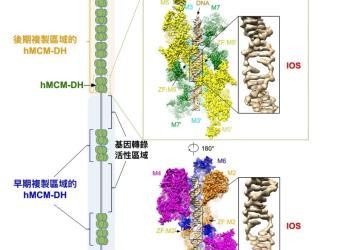
Joint study reveals how DNA unzipping machine works, shedding lights on cancer therapy
Scientists from The Hong Kong University of Science and Technology (HKUST), The University of Hong Kong (HKU) and Institut Curie, France have jointly uncovered a new mechanism of the human MCM2-7 complex in regulating replication initiation, which can be used as a novel and effective anticancer strategy with the potential for selective killing of cancer cells. The findings were recently published in the Cell journal (link to publication).
2021
News
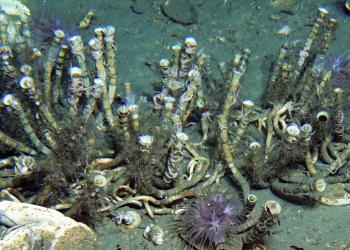
HKUST Researchers Unlock Genomic Secrets of Gutless Deep-sea Tubeworm
Researchers from The Hong Kong University of Science and Technology (HKUST) decoded for the first time the chromosomal-level genome of a deep-sea gutless tubeworm and how the worm’s co-living bacterial partners manufacture organic nutrients for its host so it can survive the extreme habitat. The discovery lays foundation for potential applications such as biomaterial production and microbial growth control.Living in deep-sea hydrothermal vents and cold seeps ecosystems characterized by darkness, high pressure and often high concentrations of toxic substances, submarine tubeworms - common living organisms of such extreme environments, were known to owe their survival and fast growth to sulphide-oxidising symbiotic bacteria that live inside their body. However, the success behind such a complementary “marriage” between the tubeworms and their co-living bacteria had remained unknown due to the lack of genomic resources.
News
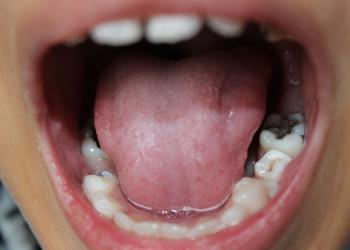
HKUST Researchers Unlock the Micro-Molecular Physiochemical Mechanism of Dental Plaque Formation
An inter-disciplinary team of researchers led by Prof. Qian Peiyuan, Chair Professor at the Hong Kong University of Science and Technology (HKUST)’s Department of Ocean Science and Division of Life Science has unraveled how a novel microbial small molecule released by Streptococcus mutans (S. mutans) – a bacterium commonly found in the human oral cavity – is connected to dental caries development using a synthetic biology approach, offering new insights to the health impact of the human oral microbiota and facilitating future research on the prevention of tooth decay. The research findings were recently published in the prestigious scientific journal Nature Chemical Biology and reported by Nature as one of the research highlights.
News
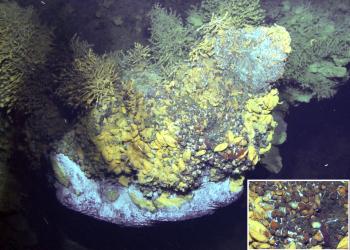
HKUST decodes a deep-sea vent-endemic snail hologenome and unveils its living strategies in the extreme environment
A research team led by Prof. QIAN Peiyuan, Head and Chair Professor from the Hong Kong University of Science and Technology (HKUST)’s Department of Ocean Science and David von Hansemann Professor of Science, has published their cutting-edge findings of symbiotic mechanisms of a deep-sea vent snail (Gigantopelta aegis) in the scientific journal Nature Communications. They discovered that Gigantopelta snail houses both sulfur-oxidizing bacteria and methane-oxidizing bacteria inside its esophageal gland cells (part of digestive system) as endosymbionts. By decoding the genomes of both snail host and two symbionts, Prof. Qian’s team disclosed a novel dual symbiosis system and the molecular adaptation to the extreme environment, gaining a new understanding of the origin of life on Earth.
News
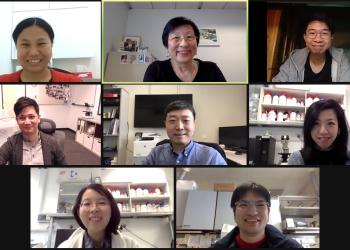
Humanizing Yeast ORC Sheds Light on Cancer Therapy and Human Development
Researchers from the Hong Kong University of Science and Technology (HKSUST) and the University of Hong Kong (HKU) recently demonstrated that the selectivity determinant of Origin Recognition Complex (ORC) for DNA binding lies in a 19-amino acid insertion helix in the Orc4 subunit, which is present in yeast but absent in human. Removal of this motif from Orc4 transforms the yeast ORC, which selects origins based on base-specific binding at defined locations, into one whose selectivity is dictated by chromatin landscape (genomic nucleosome profile), a characteristic feature shared by human ORC.
Further understanding of the preferred DNA shapes and nucleosome positioning requirements will provide new insights for the plasticity of the human ORC in selecting replication initiation sites during programmed development and disease transformation, and also help identify potential targets for anti-cancer drug screening and therapy design.
2019
News
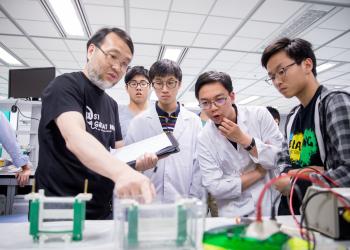
Biology Saves STEM Education from Its Shackles
STEM has been a “buzzword” in Hong Kong’s educational scene in recent years with schools investing resources in technology gadgets, but for Prof. King CHOW of Division of Life Sciences, the efforts do not seem to be on the right track. Hong Kong is a city known for rote learning, a key element of STEM education - trying to solve problems in an interdisciplinary approach - is missed out. This not only results in a cul-de-sac in science education but also an impediment to nurture innovators or scientists that Hong Kong needs.
“STEM is really about allowing students to learn about methodology, approach and principles, and rules in application. Unfortunately, in many high schools and universities in Hong Kong, students learn information but miss out on logic and the analytical aspect of it,” comments Prof. Chow.
News
Gift of 500M from LKSF to Set Up Hong Kong’s First Institute of Synthetic Biology in HKUST
The Hong Kong University of Science and Technology (HKUST) received a HK$500 million donation from Li Ka Shing Foundation (LKSF) yesterday for the establishment of Hong Kong’s first institute of synthetic biology – a best-in-class research platform focuses on synthetic biological technologies.
The new academic and research building of the “Li Ka Shing Institute of Synthetic Biology” (The Institute) will provide the most advanced facilities, aiming to attract the world’s top scholars in a move to steer Hong Kong into a global pioneer in synthetic bio-technologies.